What Bill Simmons means to us
With the news coming down that Bill Simmons and ESPN are parting ways, here’s a note to non-fans and fellow fans of Bill Simmons about why we’re so devoted
This post is an attempt to put into words what has Bill Simmons has meant to sports fans like me. That sounds sappy and morbid, and it is sappy, but it’s not morbid, because fans of Bill, like myself, will follow him wherever he goes next.
My introduction to Bill’s columns
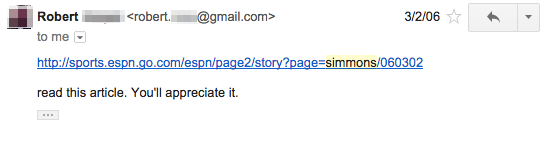
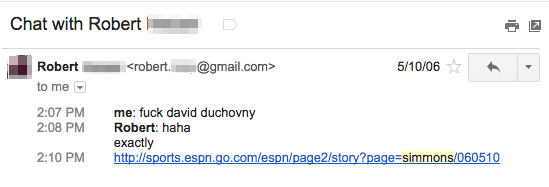
2006 was the year Gchat was introduced in Gmail. I know that because I distinctly remember sending my friends Bill Simmons, aka “The Sports Guy” (a corny moniker that belies his depth), columns over this new, amazing GChat thing that made the work day not so lonely:
Talking Simmons in the early GChat days
First, both Howard and Bill understand what consumers want from a variety of media. Many people are very good on one medium, but either don’t translate well to other mediums or don’t have those aspiration. Jon Stewart is an example of the latter. Howard conquered radio, had a hit book and movie, and is right at home on TV (on a show as stilted as The Voice, nonetheless). Howard could own Twitter or blogging if he wanted to, because he knows what people want and he knows how to deliver it, whatever the medium is. Bill is just the same across blogging, Grantland, podcasting, Twitter, and to a lesser degree, TV. Both Howard and Bill can set their fans alight with the slightest of ease; it’s in their bones.
Second, both Howard and Bill imbued their subject matter with unparalleled and unprecedented intelligence. Whereas Howard’s contemporaries wouldn’t have known what do with a stripper or porn star as a guest on their show, or wouldn’t have known what to do with them besides low-brow gags totally lacking in empathy, Howard would interview them with the same level of curiosity that he would a celebrity. (One of the most remarkable Howard bits, if you can even call it a bit because it’s real and it’s poignant, is when he invariably elicits from every stripper or porn star that they were abused as children). While Bill hasn’t traded in shock, he has imbued an otherwise doltish medium — sports — with an intelligence that extends far beyond the subject matter at hand (unlike, say, Bryant Gumbel and Bob Costas, whose intelligent takes on sports are generally bounded by the sports world; or most of the talking heads on ESPN, who never say anything original or intelligent at all). Bill is as comfortable across the table from Chuck Klosterman and Malcolm Gladwell as he is popular athletes. His columns are thousands and thousands of words. He can reference the career arcs of actors and musicians as quickly as he can his encyclopedic knowledge of Beverly Hills 90210. Fans of Howard and Bill are grateful for the acknowledgment that you can be a fan of bawdiness or sports without ceding your intellect. In fact, figures like Howard and Bill are masterful at shifting effortlessly between them.
Lastly, Howard and Bill invite you into their worlds. Robin and Gary of the Howard Stern Show are people you’d want to be friends with in real life; KC and JD served as the lovable goofballs that you wouldn’t call a friend but loved having around as foils; Artie was the friend you couldn’t apologize for. Bill has similarly made his old college friends — Joe House and Jack-O — and even his father regular guests on the podcast old college friends. I’ve always felt that listening to regular guests (both “regular” in frequency and in non-celebrity status) like that on your car stereo or in your earbuds is the closest thing to many of us have to the intimacy of our college experience. When you graduate college, friends scatter and work interrupts the long hours of just shooting the shit. What Howard and Bill (and, for tech folk, the Accidental Tech Podcast guys) give you is the closest thing you’ve got to hanging out with friends when you’re not hanging out with friends.
Hair on fire
Consider how robust my history is with Bill, considering that we’ve never met. I’ve been a reader of his for almost 10 years. I read him on the desktop computer in the lab where I used to work in the Bronx; I listened to his podcasts on my first iPod (which, not so nostalgically, I had to load on there from iTunes on my laptop), and, more recently, I set a Season Pass on Tivo for the Grantland Basketball Hour. I read his 700-page tome, “The Book of Basketball”, even though I’m a very casual basketball fan.
When I lived in Tel Aviv, I saw someone on a bus to Jerusalem settling down for the ride with a 20-page printout of Bill’s latest post. Recently I made an obscure reference to the most recent episode of the podcast with a friend, knowing that there was no chance he hadn’t listened yet. I have a standing wager with my cousin and eventual brother-in-law that if any of us ever gets in direct contact with Bill over email or on Twitter, the other two are buying him dinner. I’ve even listened to “emergency” BS Reports about Game 7’s that had already taken place and which I knew the results of but I hadn’t even seen! Think about how weird that last one is.
As Jerry Seinfeld has noted, a sports fan can consume sports commentary in even the most adverse conditions:
But there’s something fundamentally more meaningful and intimate about Bill Simmons media catalog than there ever was the Sports section. Sappy as it may sound, I’d guess that if you polled every American male and asked him to list his 10 most irreplaceable friends, and allowed him to include media figures on that list, Bill Simmons would be on several million of them.
Maybe that’s hard to understand if you’re not an American male between 18 and 45, and maybe this post is really just a form of celebrity worship. But I sure as hell hope that Bill makes like Howard and moves somewhere less ubiquitious but more liberating than ESPN, or, even better, starts his own thing, because there’s a herd of intellectually curious, culturally progressive sports fanatics like me that will follow him wherever he goes.
¯\_(ツ)_/¯